
Trichoderma is a genus of filamentous fungi commonly isolated from soil and frequently found in the rhizosphere surrounding plant roots. These fungi are saprophytic organisms capable of parasitizing and antagonizing many plant pathogenic fungi. Therefore, numerous Trichoderma spp. strains have been studied as biological control agents and applied in the production of biopesticides, biofertilizers, and soil conditioners (Harman et al., 2004).
Among the disease suppression mechanisms of Trichoderma, the secretion of enzymes capable of degrading various components of pathogen cell walls has attracted considerable research interest and has become a target for the production of enzymes with economic value (Harman, 2006; Dinh et al., 2007).
The survey results showed that strains Tricho 1 (1.2) and Tricho 3 (3.1) exhibited the highest starch-degrading efficiency, with halo zone diameters of 5.167 cm each, significantly different from those of the other strains (P < 0.05). Since the degradation zone diameter (D) was ≥ 2.5 cm, these strains were classified as having very strong amylase activity.
For strains Tricho 2 (2.2), Tricho 5 (4.2), and Tricho 6 (5.2), the halo zone diameters were 4.533 cm, 4.467 cm, and 4.667 cm, respectively. These values were significantly different from those of the remaining strains and indicated very strong enzyme activity (D ≥ 2.5 cm).
Strain Tricho 4 (3.2) produced a degradation zone diameter of 3.033 cm, while Tricho 7 (6.1) showed a diameter of 2.800 cm. There was no statistically significant difference between these two strains, and both were classified as having very strong enzyme activity (D ≥ 2.5 cm).
No significant difference was observed between Tricho 7 (6.1) and Tricho 9 (8.2). The degradation zone diameter of Tricho 9 (8.2) was 2.467 cm, indicating strong enzyme activity (D ≥ 2.0 cm).
In contrast, Tricho 8 (7.3) produced a degradation zone diameter of only 1.433 cm and was therefore classified as having moderate enzyme activity (Figure 1).
According to De Azevedo et al. (2000), Trichoderma harzianum can antagonize the plant pathogen Crinipellis perniciosa through the action of amylase enzymes, which facilitate the growth and survival of T. harzianum under field conditions. Amylase enzymes mediate the hydrolysis of starch and β-glucans.
The results of the amylase activity assessment indicated that most of the tested strains, including Tricho 1, Tricho 2, Tricho 3, Tricho 4, Tricho 5, Tricho 6, Tricho 7, and Tricho 9, exhibited very strong enzyme activity, with degradation zone diameters ranging from 2.8 cm to 5.167 cm. Only Tricho 8 displayed moderate activity, with a degradation zone diameter of 1.433 cm.
Table 1. Starch Degradation Zone Diameters of Trichoderma Strains
| No. | Trichoderma Strain | Halo Zone Diameter (cm) |
|---|---|---|
| 1 | Tricho 1 (1.2) | 5.167 a |
| 2 | Tricho 2 (2.2) | 4.533 b |
| 3 | Tricho 3 (3.1) | 5.167 a |
| 4 | Tricho 4 (3.2) | 3.033 c |
| 5 | Tricho 5 (4.2) | 4.467 b |
| 6 | Tricho 6 (5.2) | 4.667 b |
| 7 | Tricho 7 (6.1) | 2.800 cd |
| 8 | Tricho 8 (7.3) | 1.433 e |
| 9 | Tricho 9 (8.2) | 2.467 d |
Note: Halo zone diameters represent the mean values of three replicates. Within the same column, values followed by the same letter are not significantly different at the 5% significance level according to Tukey’s test.
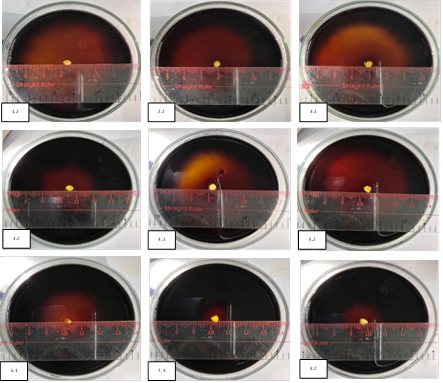
From the evaluation of enzyme activities among the nine Trichoderma isolates, most strains exhibited strong enzymatic activity. In particular, strains Tricho 2, Tricho 3, Tricho 5, and Tricho 6 demonstrated higher amylase activity than the other strains throughout the investigation.
Ngày đăng: 07-04-2026
Tác giả: Trung tâm ứng dụng