
Betel vine (Piper betle) is a traditional medicinal plant mainly distributed in tropical regions, with its leaves being the most widely studied and utilized part of the plant. In traditional medicine, betel leaves are used as a mouthwash in India and Thailand and for treating oral health problems, headaches, and arthritis in Malaysia. In Sri Lanka, betel leaf juice is used to treat certain skin conditions. In addition, betel leaves are also used as a cough remedy, tonic, or astringent (Joesoef et al., 1996; Arambewela et al., 2010; Chowdhury et al., 2020).
The applications of betel leaves are associated with their antibacterial and antifungal properties. Betel leaf essential oil and extracts have been shown to inhibit the growth of various Gram-negative bacteria, including Escherichia coli, Pseudomonas aeruginosa, Acinetobacter baumannii, and Klebsiella pneumoniae; Gram-positive bacteria such as Staphylococcus aureus, Propionibacterium acnes, Streptococcus pyogenes, Staphylococcus epidermidis, and Enterococcus faecalis; as well as various fungal species, including multidrug-resistant fungi and those associated with serious diseases, such as Aspergillus flavus, Aspergillus fumigatus, Aspergillus parasiticus, Candida albicans, Candida glabrata, Candida parapsilosis, Epidermophyton floccosum, Trichophyton mentagrophytes, Trichophyton rubrum, and Microsporum canis (Nayaka et al., 2021).
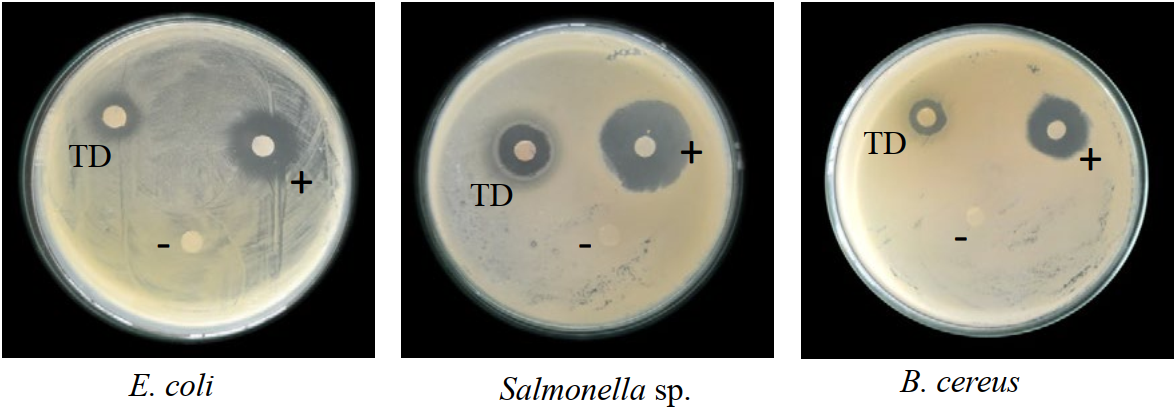
(+) 0.2% tetracycline; (-) deionized water; (TD) essential oil.
The chemical composition of betel leaf essential oil varies considerably depending on its geographical origin, plant age, and harvesting time. Analytical results from Indian betel leaf essential oil indicate that it mainly contains phenylpropanoid compounds such as acetyl eugenol, eugenol, chavicol, and safrole. Meanwhile, essential oils from betel leaves examined in other studies have been found to contain common compounds such as estragole, linalool, α-copaene, anethole, caryophyllene, α-terpinene, 1,8-cineole, β-caryophyllene, α-humulene, allyl pyrocatechol, allylcatechol, methyl eugenol, estragole (methyl chavicol), chavibetol, chavibetol acetate, safrole, 4-allyl-2-methoxy-phenol acetate, and 3-allyl-6-methoxyphenol (Madhumita et al., 2019; Salehi et al., 2019).
In addition to essential oil, betel leaves contain a wide range of other compounds, including steroids, tannins, proteins, amino acids, flavonoids, terpenoids, saponins, and carbohydrates. Betel leaves are considered a rich and promising herbal resource for applications in the food and pharmaceutical industries.
This study was conducted to maximize the utilization of betel leaves by obtaining essential oil extracts with potential applications in the development of alternatives to conventional synthetic antibiotics, particularly plant-based antimicrobial products derived from betel leaves. Furthermore, their antibacterial activity against intestinal bacteria may offer potential applications in food preservation, while these natural compounds may also be applied in the cosmetics sector, particularly in products targeting bacterial and fungal skin conditions.
Proposed Extraction Process for Betel Leaf Essential Oil
Betel leaf essential oil was extracted using steam distillation assisted by ultrasonic waves for 30 minutes, with a fresh material-to-water ratio of 1:4 (w/v) and a distillation time of 4 hours (Nguyen et al., 2016).
After the distillation process was completed, the condensate collected in the receiving tube was transferred into a separatory funnel. Then, 50 mL of n-hexane was added, and the mixture was thoroughly shaken and allowed to settle. The liquid separated into two layers, and the upper layer was collected into a round-bottom flask. The lower layer was then extracted a second time with another 50 mL of n-hexane. The resulting upper layer was collected and combined with the previous extract. The essential oil was subsequently recovered by vacuum rotary evaporation to remove the solvent.
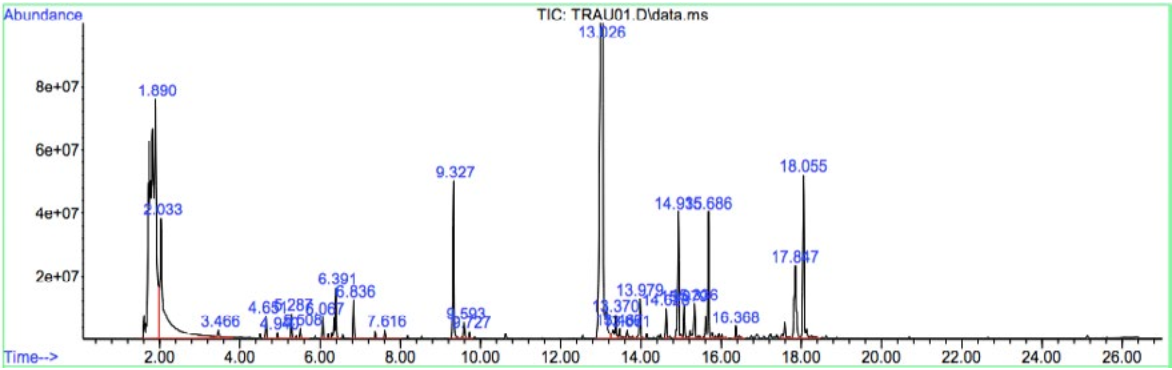
The essential oil content of the betel leaves was 3.14%. The essential oil contained major compounds including eugenol (50.37%), γ-muurolene (9.65%), and α-copaene (8.22%).
Betel leaf essential oil demonstrated antioxidant activity, with an IC₅₀ value of 0.13 mg/mL. It also exhibited antibacterial activity against three bacterial strains, namely Escherichia coli, Salmonella sp., and Bacillus cereus, with inhibition zone diameters of 7.67 mm, 8.33 mm, and 6.33 mm, respectively.
Nguồn bài viết: https://ttud.com.vn/public/dich-vu/thi-nghiem-cong-nghe-sinh-hoc/nghien-cuu-thu-nhan-tinh-dau-tu-la-trau-piper-betle
Ngày đăng: 17-07-2026
Tác giả: Trung tâm ứng dụng