
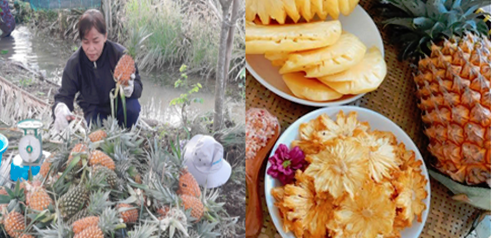
Cầu Đúc pineapple belongs to the Queen variety. In general, this variety is characterized by its elegant fruit shape, short stem, small core, prominent eyes, slightly deep eye cavities, dark yellow flesh, low fiber content, and relatively low water content. The flesh is crisp and sweet. Cầu Đúc pineapple, a Queen pineapple variety traditionally associated with Cầu Đúc, Hậu Giang (now part of Cần Thơ City), is considered one of the local specialty crops with high economic value.
The economic efficiency of pretreatment methods for the drying process and the quality characteristics of soft-dried pineapple were studied. Factors affecting product processing include pineapple maturity and the concentration of the osmotic solution (30–45°Brix). Pineapple slices were dried at temperatures ranging from 60–65°C until the final moisture content reached 15–20%, producing a basically dried product.
1. Pineapple Processing Process
1.1. Processing Process
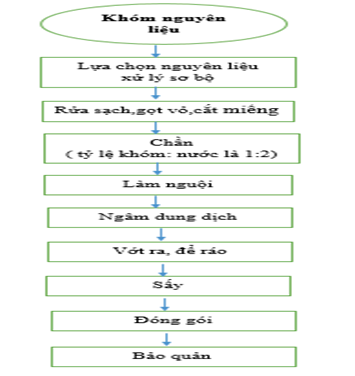
1.2. Process Description
1.2.1. Pretreatment
a. Technological purpose:
- Classify the raw materials and remove fruits that do not meet specifications, as well as fruits affected by pests, diseases, mold, or spoilage.
- Ensure uniformity in the size, shape, color, and maturity of the raw materials.
b. Method:
The raw materials are inspected and selected. Rotten, pest-damaged, diseased, or insect-damaged fruits are removed, along with foreign materials such as leaves, debris, and other unwanted objects. Preliminary washing may be carried out before grading if the fruits are excessively dirty.
Fruits that have not yet reached the appropriate maturity level may be stored until they reach the desired maturity before processing. Overripe fruits may also be used as long as they do not show signs of spoilage.
1.2.2. Slicing
a. Purpose:
The raw material is cut into smaller slices to facilitate the drying process and help create the characteristic texture of the finished product.
b. Technical specification:
The pineapple is cut into slices of an appropriate thickness.
1.2.3. Blanching
a. Purpose:
- Destroy microorganisms.
- Inactivate the polyphenol oxidase enzyme system, which may cause discoloration of the raw material.
- Preserve the natural color of the fruit.
- Reduce the amount of gases in the intercellular spaces of the raw material, thereby limiting the effects of oxygen that can oxidize vitamins or catalyze other oxidation reactions.
b. Method:
The raw material is exposed to steam for a specified period to achieve the desired physical, chemical, and biological changes.
c. Changes during blanching:
Physical changes:
Blanching alters the volume and weight of the raw material, facilitating subsequent processing steps. It reduces the firm and brittle structure, produces a cooked aroma, and may cause the loss of some dry matter.
Chemical changes:
The fruit may become lighter in color due to the destruction of certain pigments. Some aroma compounds may evaporate. Minerals, water-soluble vitamins, and other water-soluble compounds may be lost during blanching.
Physicochemical changes:
Blanching increases the permeability of the protoplasm, allowing cellular fluids to escape more easily. Some soluble compounds may also be extracted into the blanching water.
Biological changes:
A portion of microorganisms is destroyed, mainly those present on the surface of the raw material.
d. Factors affecting blanching:
- Pineapple variety and maturity: Overripe pineapples may not be suitable for blanching because they can become excessively soft and mushy.
- Raw material pretreatment methods: Cutting and peeling operations that cause bruising before blanching can negatively affect blanching quality.
- Blanching solution: Blanching increases the volume of capillaries, making cellular fluids more likely to escape and resulting in nutrient loss.
- Contact area between the raw material and blanching water: The larger the contact area, the greater the loss of soluble compounds.
- Blanching time and temperature: These directly affect color changes and vitamin loss. Vitamin loss can be reduced by blanching at a high temperature for a short period.
- Cooling method: Rapid cooling helps minimize undesirable changes in the raw material after blanching.
e. Equipment:
In blanching equipment, different layers of raw materials may not be heated uniformly. Therefore, the temperature and time required to ensure enzyme and microorganism inhibition in the inner layers may result in overheating of the outer layers, causing significant changes in quality. Shortening the blanching time can improve processing efficiency and help maintain raw material quality.
1.2.4. Soaking in Solution
The following substances are added to the sugar solution during soaking:
- K₂S₂O₃: Helps inhibit browning reactions and improve the color of the finished product.
- Ascorbic acid: Used as a preservative and antioxidant to prevent oxidation during drying, helping preserve the natural aroma and prevent undesirable changes in color and texture.
Technical specifications:
- Soaking solution temperature: 5–6°C
- Soaking time: 6 hours
1.2.5. Drying
Method: Hot-air drying.
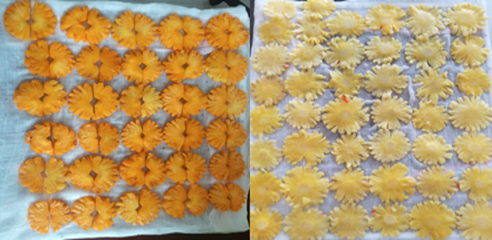
The product is arranged on drying trays and placed in the dryer. When arranging the product on the trays, an even distance should be maintained between the slices. The slices should not overlap, as this can result in uneven drying.
Technical specifications:
- Drying temperature: 60–65°C
- Drying time: 10–12 hours
- Final moisture content: 15–20%
Changes occurring during drying:
When exposed to heat, a certain amount of water is removed from the product.
Texture:
The overall volume of the product decreases. The outer surface shrinks and becomes wrinkled, resulting in significant changes in texture.
Flavor:
The product has a slightly sour taste, but is predominantly characterized by the natural sweetness of the pineapple.
Color:
The color changes from light yellow to a deeper yellow.
Product requirements:
The product should be evenly ripened and have an attractive orange-yellow color. The pineapple pieces should be dry on the surface while retaining an appropriate degree of softness and flexibility. The characteristic sweet and aromatic flavor of the raw material should be preserved.
2. Packaging
The packaging process is carried out using a vacuum packaging machine with PE packaging bags measuring approximately 18 × 26 cm. Each finished package contains 100 g of product, or packaging specifications may vary depending on the product.
3. Storage
Because fresh pineapple contains a high amount of water, soft-dried pineapple generally has a relatively short shelf life. If the product is dried excessively, it will lose its characteristic soft and chewy texture. Therefore, consuming the soft-dried pineapple within 30 days from the date of packaging is recommended; earlier consumption is preferable to maintain quality and avoid fermentation and discoloration.
The typical shelf life is 2 months, which represents the maximum storage period under cool weather conditions. Soft-dried pineapple should not be stored in a refrigerator, as low temperatures may cause the product to harden and lose its soft texture. Therefore, when the product is not consumed immediately, it should be stored in a cool, dry place.
Nguồn bài viết: https://ttud.com.vn/public/dich-vu/thi-nghiem-cong-nghe-sinh-hoc/hoan-thien-quy-trinh-khom-say-deo
Ngày đăng: 23-06-2026
Tác giả: Trung tâm ứng dụng