
This study aims to develop a process for producing melon snacks from undersized melons using vacuum frying technology. The objective is to utilize abundant melon resources that do not meet commercial size standards to create value-added products and reduce agricultural waste.
Melon (Cucumis melo var. reticulatus), belonging to the family Cucurbitaceae, is a fruit vegetable crop characterized by a short growth cycle, high yield, and the ability to be cultivated in multiple seasons throughout the year. The fruit is typically oval-shaped, with a green skin that gradually turns yellowish-green as it ripens. It is distinguished by interwoven white veins that form its characteristic net-like pattern (Endl et al., 2018). Commercial fruits generally weigh between 1.2 and 3.0 kg, with yellow-orange flesh that is crisp, sweet, and juicy. In Vietnam, melon cultivation developed rapidly from 2018, beginning in Ninh Thuan Province and subsequently expanding throughout the provinces of the Mekong Delta. The crop has provided raw materials for various processed products, including powder, ice cream, bottled beverages, and fruit jelly (Vietnam Academy of Agricultural Sciences, 2022).
During cultivation, melons are regularly pruned to concentrate nutrients on fruits that meet quality standards. However, a significant concern arises at the harvesting stage: a large quantity of fruits may have reached the required maturity, with adequate sugar content (Brix > 12) and nutritional value, but fail to meet standard commercial sizes (below 1.5 kg per fruit for Japanese melon varieties). These fruits are referred to as undersized or non-commercial melons.
Because they do not meet the appearance requirements for retail chains or export markets, farmers often have to discard them directly at the farm. The failure to utilize this abundant source of raw materials not only significantly reduces economic value but also increases agricultural waste.
To address the market outlet for undersized melons, vacuum frying technology was selected due to its significant advantages. This frying process is based on the principle of water transitioning from a solid state to a vapor state under vacuum conditions. The technology can help maximize the retention of heat-sensitive bioactive compounds, such as vitamin C, beta-carotene, and antioxidant compounds, which are abundant in melons.
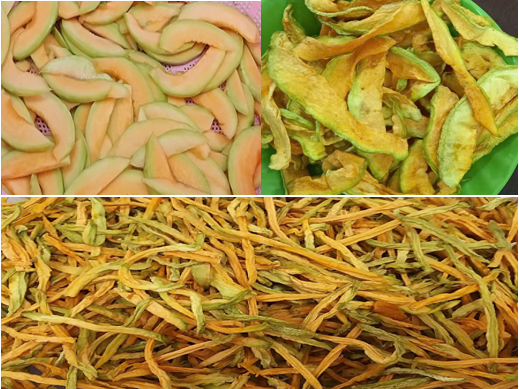
The fried product retains its natural color, characteristic flavor, and a distinctive porous and crispy texture that cannot be achieved through conventional frying methods. The major challenge of this technology is the high initial equipment investment and energy consumption, as it requires a vacuum frying system operating at 100–120°C and a vacuum pump capable of maintaining extremely low pressure (< 5 Pa) for an extended period.
However, the added value generated by extending shelf life while maintaining high product quality provides the product with significant competitive advantages in the premium food market.
Technological Process
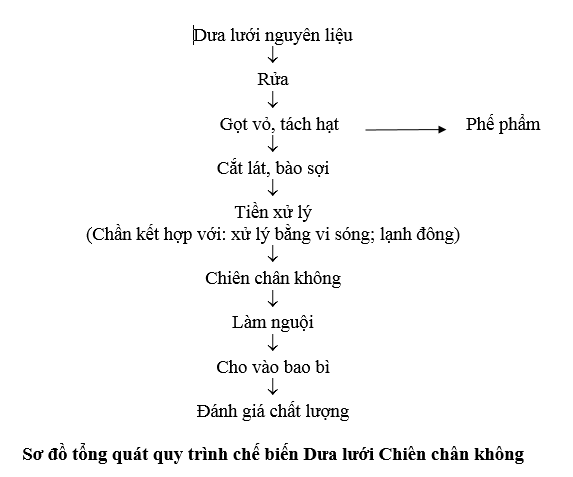
Vacuum frying technology has been successfully applied worldwide and in Vietnam to various high-value fruits, such as jackfruit and bananas, to produce nutritious snack products. However, applying this technology to transform undersized melons into snack products remains a relatively new direction.
Developing melon-based snacks not only diversifies the range of healthy food products but also contributes to promoting sustainable agricultural practices and improving farmers' incomes.
Nguồn bài viết: https://ttud.com.vn/public/dich-vu/thi-nghiem-cong-nghe-sinh-hoc/xay-dung-quy-trinh-cong-nghe-san-xuat-snack-dua-luoi
Ngày đăng: 18-06-2026
Tác giả: Trung tâm ứng dụng